Ueno Station
Ueno’s Tohoku Shinkansen feature is a high-speed-rail reference, with different planning needs from the Yamanote entries in this sample. The record alone is not a train or seat reservation.
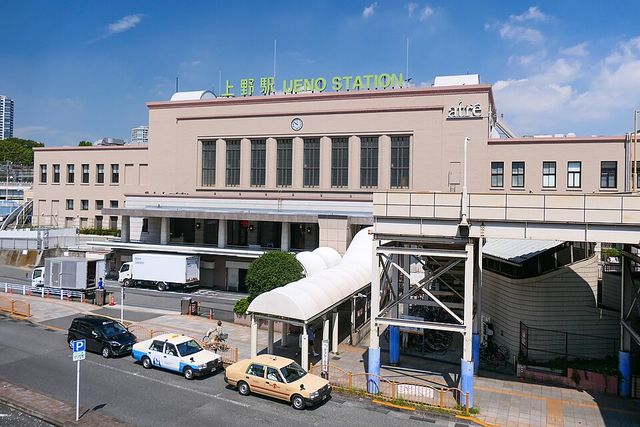
JRE-Ueno-STA.jpg · MaedaAkihiko · CC BY-SA 4.0
Unmodified image file; scaled to fit the page. Photo remains under its stated license.
- Station
- Ueno (上野)
- Line
- Tohoku Shinkansen (東北新幹線)
- Operator
- East Japan Railway Company (東日本旅客鉄道)
- MLIT dataset ID
- 003505 — a dataset identifier, not a passenger signage number
- Dataset reference date
- 2025-12-31
Locate the relevant station layer
JR East’s Ueno page includes an underground B4-to-B1 map as well as its above-ground plans. Use the operator’s diagram to follow the route from your arriving service to the Shinkansen area, rather than assume that every platform shares the same concourse.
Choose a service before counting stops
An editorial booking checklist is to establish the exact train, departure and arrival stations, date and seat arrangement. The words “Tohoku Shinkansen” in a geographic record cannot establish that a given train stops at your chosen station or that a seat is available. Consult current operator information for those decisions.
What the preserved record can support
The MLIT snapshot is referenced to 31 December 2025 and identifies a station-line feature operated by JR East. It is useful for geographic reference and matching names. Live operation, fares, platform changes and accessible-route availability are different datasets; the new reading guide does not fill those gaps with assumptions.
Article sources
About this station
Ueno Station (Japanese: 上野駅, Hepburn: Ueno-eki) is a major railway station in Tokyo's Taitō ward. It is the station used to reach the Ueno district and Ueno Park—which contains Tokyo National Museum, The National Museum of Western Art, Ueno Zoo, Tokyo University of the Arts and other famous cultural facilities. A major commuter hub, it is also the traditional terminus for long-distance trains from northern Japan, although with the extension of the Shinkansen lines to Tokyo Station this role has diminished in recent years. A similar extension of conventional lines extended Takasaki Line, Utsunomiya Line and Jōban Line services to Tokyo Station via the Ueno-Tokyo Line in March 2015, using existing little-used tracks and a new viaduct; the Ueno-Tokyo Line connects these lines with the Tōkaidō Main Line, allowing through services to Shinagawa, Yokohama, Odawara and Atami stations. Ueno Station is close to Keisei Ueno Station, the Tokyo terminus of the Keisei Main Line to Narita Airport Station.
Lines
This station is served by the following lines:
Tokyo Metro Ginza Line Hibiya Line East Japan Railway Company Tōhoku Shinkansen Yamagata Shinkansen Akita Shinkansen Jōetsu Shinkansen Hokuriku Shinkansen Hokkaido Shinkansen Utsunomiya Line (Tōhoku Main Line) Takasaki Line Keihin–Tōhoku Line Yamanote Line Jōban Line As this station was the traditional point of arrival and departure for journeys to northern Japan, it became the inspiration for many poems and song lyrics, including a famous poem by Ishikawa Takuboku. There is a memorial plate about this poem in the station.
Station layout
Like most major stations in Japan, Ueno Station contains and is surrounded by extensive shopping arcades. The station contains a branch of the Hard Rock Cafe.
JR East platforms
The station has two main levels of tracks and underground platforms for the Tōhoku Shinkansen tracks. Through tracks 1 to 4 on two island platforms on the main level are used by Yamanote Line and Keihin-Tohoku Line trains. Tracks 5 to 9 on two island platforms and one side of a terminal platform lead to the Ueno-Tokyo Line to Tokyo Station and beyond on the Tōkaidō Main Line. Tracks 10 to 12 terminate inside the building, and below these on a lower deck are further terminal tracks 13 to 17 (Track No.18 has been removed). Two underground island platforms serve Shinkansen tracks 19 to 22. Chest-high platform edge doors were installed on the two Yamanote Line platforms (2 and 3) in November 2015, and brought into use from December.
Tokyo Metro platforms
Both the Ginza and Hibiya line station have two tracks; however, unlike in other Tokyo Metro stations, each line's tracks are counted separately.
History
Ueno Station opened on 28 July 1883. After the destruction of the first building in the fires caused by the 1923 Great Kantō earthquake, Japanese Government Railways constructed the current station building. While digging the foundations of the new building, bones, swords, and lances dating from the Battle of Ueno were excavated. In 1927, Tokyo Underground Railway (now Tokyo Metro) opened Japan's first subway line from here to Asakusa Station.
During World War II and the following years, many war orphans found refuge in the station and its underground tunnels. Following World War II, the neighbourhood in front of Ueno Station was a major center of black market activity. Today, many people come to the area to visit Ameya-Yokochō. In March 1985, the Tōhoku Shinkansen was extended south from Ōmiya to Ueno, with the line extended further south to Tokyo in June 1991. The station facilities of the Ginza and Hibiya Lines were inherited by Tokyo Metro after the privatization of the Teito Rapid Transit Authority (TRTA) in 2004. In March 2010, to promote the release of the Cho-Den-O Trilogy of the Kamen Rider movies, a special marking was used on the trains going to Nakano-fujimichō from Ueno, and Den-O's Rina Akiyama greeted 200 fans who rode on the first of those trains. Station numbering was introduced to the non-Shinkansen JR East platforms in 2016 with Ueno being assigned station numbers JU02 for the Utsunomiya line, JJ01 for the Jōban Line rapid service, JK31 for the Keihin–Tōhoku Line, and JY05 for the Yamanote line. At the same time, JR East assigned the station a three-letter code to its major transfer stations; Ueno was assigned the code "UEN". TH Liner services on the Hibiya Line between Ebisu and Kuki commenced on 6 June 2020.
In March 2020, the Park Exit (Ueno Park Exit) was moved to the north and the roadway in front of it was changed to a dead end, allowing pedestrians to enter Ueno Park from the station without crossing the roadway.
Passenger statistics
In fiscal 2013, the JR East station was used by 181,880 passengers daily (boarding passengers only), making it the thirteenth-busiest station operated by JR East. In fiscal 2013, the Tokyo Metro station was used by an average of 211,539 passengers per day (exiting and entering passengers), making it the eighth-busiest station operated by Tokyo Metro. The daily passenger figures for each operator in previous years are as shown below.
Note that JR East figures are for boarding passengers only.
Highway buses
Sky / Panda; For Hirosaki, Aomori Station Yuhi; For Tsuruoka Station, Amarume Station, and Sakata Station Tono Kamaishi; For Shin-Hanamaki Station, Tōno Station, Kamaishi Station, and Yamada Tokyo Sunrise; For Yamagata Station, Sagae Station, Sakurambo-Higashine Station, and Shinjō Station Rainbow; Yonezawa Station, Kaminoyama-Onsen Station, and Yamagata Station For Chino, Matsumoto Bus Terminal, and Nagano Station Dream Kanazawa; For Toyama Station, Kanazawa Station, and Kanazawa Institute of Technology Kimasshi; For Kanazawa Station Yamato; For Tenri Station, Nara Station, Kintetsu-Kōriyama Station, Hōryū-ji, Ōji Station, and Goidō Station For Ōtsu Station, Yamashina Station, Sanjō Station, and Kyōto Station Flying Liner; For Kyōto Station, Ōsaka Station, Ōsaka Namba Station, Ōsaka Abenobashi Station, and Fujiidera Station Mamakari Liner; For Okayama Station, Kurashiki Station
In Literature
Tokyo Ueno Station, by Yu Miri, English tr. by Morgan Giles Archived 2020-11-19 at the Wayback Machine (Tilted Axis, 2019. ISBN 978-1911284161 // Penguin Randomhouse, 2020. ISBN 978-0593088029)
About text adapted from the Wikipedia article Ueno Station by its contributors (CC BY-SA 4.0).
Source and licence
出典:国土数値情報(鉄道データ)国土交通省 — このページは「国土数値情報(鉄道データ)N02-2025」を加工して作成した。
Source: National Land Numerical Information (Railway data) N02-2025, Ministry of Land, Infrastructure, Transport and Tourism, Japan; processed and formatted by GIZUMO. Dataset reference date: 2025-12-31. Dataset page: MLIT N02-2025. This archive is a selected sample of station/line features, not live travel information; timetables and current operations are not supplied.