Shinagawa Station
Shinagawa’s Yamanote entry should not be stretched into a record of every service using the station. The operator and line in this snapshot define a narrower object than the whole interchange.
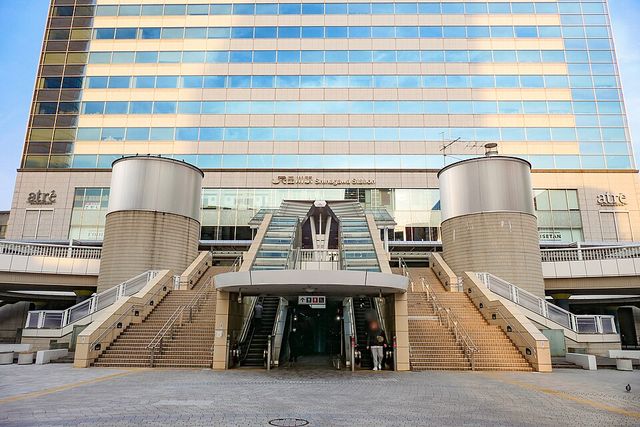
Shinagawa-STA East.jpg · MaedaAkihiko · CC BY-SA 4.0
Unmodified image file; scaled to fit the page. Photo remains under its stated license.
- Station
- Shinagawa (品川)
- Line
- Yamanote Line (山手線)
- Operator
- East Japan Railway Company (東日本旅客鉄道)
- MLIT dataset ID
- 004097 — a dataset identifier, not a passenger signage number
- Dataset reference date
- 2025-12-31
One station, more than one planning question
JR East’s station guide offers first- and second-floor maps. Use them to identify the relevant gate and platform area for your own connection. A Yamanote feature is not proof of a Shinkansen ticket, an airport route or through-ticket coverage; those require the specific service and operator information.
Keep the ticket question separate
An editorial planning method is to write down the next operator and service name before looking for a transfer route. Then check whether your ticket covers that segment and how the interchange works. A geographic dataset cannot resolve fare products or tell you which train to board.
What the preserved record can support
The MLIT snapshot is referenced to 31 December 2025 and identifies a station-line feature operated by JR East. It is useful for geographic reference and matching names. Live operation, fares, platform changes and accessible-route availability are different datasets; the new reading guide does not fill those gaps with assumptions.
Article sources
About this station
Shinagawa Station (Japanese: 品川駅, Hepburn: Shinagawa-eki) is a major railway station in the Takanawa and Konan districts of Minato, Tokyo, Japan, operated by East Japan Railway Company (JR East), Central Japan Railway Company (JR Central), and the private railway operator Keikyu. The Tokaido Shinkansen and other trains to the Miura Peninsula, Izu Peninsula, and the Tōkai region pass through here. Though a major station in Tokyo, Shinagawa is not served by the Tokyo subway network. However, it is connected to the Toei Asakusa Line via Keikyu through services. Despite its name, the station is not located in Shinagawa ward. Shinagawa is also commonly used to refer to the business district around the station, which is in Takanawa and Konan neighborhoods of Minato, directly north of Shinagawa ward. This station is just south of a large yard complex consisting of Shinagawa Carriage Sidings, Shinagawa Locomotive Depot, and Tamachi Depot.
Lines
Shinagawa is served by the following lines:
JR Central
Tokaido Shinkansen
JR East
Keihin–Tōhoku Line Tōkaidō Line Yamanote Line Yokosuka Line
Keikyu
Keikyu Main Line JR Central announced in 2011 that Shinagawa will be the terminal for the Chūō Shinkansen, a maglev line under construction and scheduled to begin service to Nagoya no earlier than 2035.
History
Shinagawa is one of Japan's oldest stations, opened on 12 June 1872, when the service between Shinagawa and Yokohama provisionally started, four months before the inauguration of "Japan's first railway" between Shimbashi and Yokohama through Shinagawa on 14 October 1872. Later on 1 March 1885, the Yamanote Line started operation. Takanawa station of the Keikyu Line (then Keihin Railway Line) opened on 11 March 1924 across the street from Shinagawa station. Takanawa station was renamed Shinagawa station and moved to the current site on 1 April 1933. The Shinagawa station for the Tokaido Shinkansen opened on 10 October 2003. Some services did not stop on the station for the until March 2008. It is said that Kasai Yoshiyuki influenced the construction of the station to encourage travelers to pick Shinkansen over airplane as a form of transport. The Tokyo branch office of JR Central was built on top of the station. Keikyu introduced station numbering to its stations on 21 October 2010; Shinagawa was assigned station number KK01. Station numbering was introduced to the JR East platforms in 2016 with Shinagawa being assigned station numbers JT03 for the Tokaido Line, JO17 for the Yokosuka Line, JK20 for the Keihin-Tohoku Line, and JY25 for the Yamanote Line. At the same time, JR East assigned the station a 3-letter code; Shinagawa was assigned the code "SGW".
Future plans
New ground level Keikyu platforms are currently undergoing construction and are expected to be completed around 2030 as part of the Keikyu's Continuous Grade Separation project. On 28 January 2022, Tokyo Metro announced that a 2.5 km (1.6 mi) spur line of Tokyo Metro Namboku Line from Shirokane-takanawa to Shinagawa would be built. The extension is expected to cost ¥131 billion (2021) (equivalent to ¥142.46 billion or US$941.14 million in 2024) and scheduled to begin revenue service in the mid-2030s. The subway line platforms will be in a cut and cover tunnel beneath the current station forecourt on the west side of the station.
Station layout
The main JR station concourse is situated above the platforms running east–west across the breadth of the station. A freely traversable walkway divides the station into two sections. The southerly section contains a number of shops and market-style stalls which form the "e-cute" station complex. Cross-platform interchange between the Yamanote and Keihin-Tohoku lines is only available for Yamanote Line trains to Shibuya and Keihin-Tōhoku Line trains to Tokyo. The Keikyu platforms are on the western side of the station at a higher level than the JR platforms. Some Keikyu trains terminate at Shinagawa while others continue on to join the Toei Asakusa Line at Sengakuji. The Shinkansen platforms were opened on October 1, 2003, to relieve congestion at Tokyo Station. Platforms are on the east side of the station.
Passenger statistics
In fiscal 2017, the JR East station was used by an average of 378,566 passengers daily (boarding passengers only), making it the fifth-busiest station operated by JR East. The passenger figures for previous years are as shown below.
West side (Takanawa Exit)
Aqua Park Shinagawa National Route 15 Shinagawa East One Tower
East side (Konan Exit)
Tokyo University of Marine Science and Technology
Bus services
Services are provided by Toei Bus, Tokyu Bus, Keikyu Bus, Airport Transport Service, and others.
About text adapted from the Wikipedia article Shinagawa Station by its contributors (CC BY-SA 4.0).
Source and licence
出典:国土数値情報(鉄道データ)国土交通省 — このページは「国土数値情報(鉄道データ)N02-2025」を加工して作成した。
Source: National Land Numerical Information (Railway data) N02-2025, Ministry of Land, Infrastructure, Transport and Tourism, Japan; processed and formatted by GIZUMO. Dataset reference date: 2025-12-31. Dataset page: MLIT N02-2025. This archive is a selected sample of station/line features, not live travel information; timetables and current operations are not supplied.