Akihabara Station
Akihabara’s “Sobu Line” field is a dataset label. It should be paired with a present-day operator route and station map before you infer a service pattern from the line name alone.
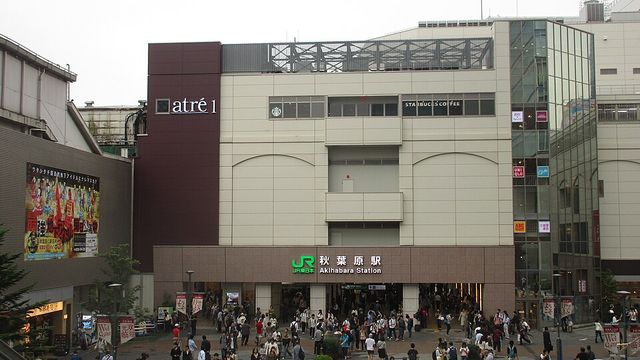
JRAkihabara station.jpg · ヒタチギ · CC BY-SA 4.0
Unmodified image file; scaled to fit the page. Photo remains under its stated license.
- Station
- Akihabara (秋葉原)
- Line
- Sobu Line (総武線)
- Operator
- East Japan Railway Company (東日本旅客鉄道)
- MLIT dataset ID
- 003626 — a dataset identifier, not a passenger signage number
- Dataset reference date
- 2025-12-31
Choose the map for the right layer
JR East offers first-floor, middle-level and third-floor diagrams for Akihabara. That structure is a useful reminder to trace vertical movement during a connection, rather than judge interchange difficulty only by the distance between map points.
A precise question beats a broad label
An editorial journey check asks for the train’s destination and stopping pattern, then the appropriate platform and gate. Do not assume that all services bearing a familiar line-family name call at the same platforms or stations. The source here supplies no timetable, service frequency or guaranteed connection.
What the preserved record can support
The MLIT snapshot is referenced to 31 December 2025 and identifies a station-line feature operated by JR East. It is useful for geographic reference and matching names. Live operation, fares, platform changes and accessible-route availability are different datasets; the new reading guide does not fill those gaps with assumptions.
Article sources
About this station
Akihabara Station (秋葉原駅, Akihabara-eki) is an interchange railway station in Chiyoda, Tokyo, Japan. It is at the center of the Akihabara shopping district specializing in electronic goods.
Lines
Akihabara Station is served by the following lines. JR East:
Tōhoku Main Line Keihin-Tohoku Line Yamanote Line Sōbu Main Line Chūō-Sōbu Line Tokyo Metro:
Hibiya Line Metropolitan Intercity Railway Company:
Tsukuba Express The above-ground section of the station is cross-shaped, with the Chūō-Sōbu Line tracks running from east to west, and the Yamanote and Keihin-Tohoku Line (and Tohoku Shinkansen and Ueno–Tokyo Line, which do not stop at Akihabara) from north to south.
JR East
There are two island platforms serving four tracks for the Yamanote Line and the Keihin-Tohoku Line on the 2nd level, and two side platforms serving two tracks for the Sobu Line Local service on the 4th level.
Chest-high platform edge doors were installed on the Yamanote Line platforms in May 2015, to be brought into operation from 20 June 2015.
Tokyo Metro
There are two underground side platforms serving two tracks.
The song "Koi Suru Fortune Cookie" by AKB48 is to be used as the departure melody on the Hibiya Line platforms from spring 2016.
Tsukuba Express
There is an underground island platform serving two tracks.
History
Akihabara Station was opened in November 1890 as a freight terminal linked to Ueno Station via tracks following the course of the modern day Yamanote Line. It was opened to passenger traffic in 1925 following the construction of the section of track linking Ueno with Shimbashi via Tokyo Station and the completion of the Yamanote Line. The upper-level platforms were added in 1932 with the opening of an extension to the Sōbu Line from its old terminal at Ryōgoku to Ochanomizu, making Akihabara an important transfer station for passengers from the east of Tokyo and Chiba Prefecture. The huge growth in commuter traffic following the Second World War caused considerable congestion and was only relieved with the construction of the Sōbu line tunnel linking Kinshichō with Tokyo, bypassing Akihabara. The Hibiya Line subway station was opened on May 31, 1962, with the line's extension from Naka-Okachimachi to Ningyōchō. The station facilities of the Hibiya Line were inherited by Tokyo Metro after the privatization of the Teito Rapid Transit Authority (TRTA) in 2004. On August 24, 2005, the underground terminus of the new Tsukuba Express Line opened at Akihabara. The entire station complex, including the JR station, was also refurbished and enlarged in preparation for the opening of the Tsukuba Express. Station numbering was introduced in 2016 with Akihabara being assigned station numbers JY03 for the Yamanote line, JK28 for the Keihin-Tōhoku line, and JB19 for the Chūō-Sōbu line. At the same time, JR East assigned a three-letter code to their major interchange stations; Akihabara was assigned the three-letter code "AKB". TH Liner services on the Hibiya Line between Ebisu and Kuki commenced on 6 June 2020.
Passenger statistics
In fiscal 2013, the JR East station was used by an average of 240,327 passengers daily (boarding passengers only), making it the ninth-busiest station operated by JR East. Over the same fiscal year, the Tokyo Metro station was used by an average of 122,576 passengers daily (both exiting and entering passengers), making it the 23rd busiest Tokyo Metro station. The passenger figures for previous years are as shown below. Note that JR East figures are for boarding passengers only.
Surrounding area
The main attraction is the Akihabara electronics retail district to the north and west of the station.
Iwamotocho Station ( Toei Shinjuku Line) Suehirocho Station ( Tokyo Metro Ginza Line)
Route buses
Cha 51(茶51); For Ochanomizu Station, Hongō-sanchōme Station, and Komagome Station Aki 26(秋26); For Kanda Station, Iwamotochō Station, Kiyosumi-shirakawa Station, and Kasai Station Kazaguruma Akihabara Route; For Ochanomizu Station, Chiyoda City Office Kazaguruma Akihabara Route; For Ochanomizu Station, Chiyoda City Office
Highway buses
My Town Direct Bus; For Tokyo Disney Resort, Shin-Urayasu Area Airport Limousine; For Haneda Airport Kanto Yakimono Liner; For Kasama Station, Mashiko Station For Takasaki Station, Shin-Maebashi Station, Maebashi Station, and Maebashi Bus Center Tono Kamaishi; For Shin-Hanamaki Station, Tōno Station, Kamaishi Station, Kirikiri, and Yamada Yuhi; For Tsuruoka Station, Amarume Station, and Sakata Station Southern Cross; For Kyōto Station, Ōsaka Station, Namba Station, and Osaka City Air Terminal (JR Namba Station) Tokyo Tokkyu New Star; For Kyōto Station, Ōsaka Station, Universal Studios Japan, Tennōji Station, Ōsaka Uehommachi Station, and Fuse Station For Toyama Station, Kanazawa Station, and Kenroku-en
About text adapted from the Wikipedia article Akihabara Station by its contributors (CC BY-SA 4.0).
Source and licence
出典:国土数値情報(鉄道データ)国土交通省 — このページは「国土数値情報(鉄道データ)N02-2025」を加工して作成した。
Source: National Land Numerical Information (Railway data) N02-2025, Ministry of Land, Infrastructure, Transport and Tourism, Japan; processed and formatted by GIZUMO. Dataset reference date: 2025-12-31. Dataset page: MLIT N02-2025. This archive is a selected sample of station/line features, not live travel information; timetables and current operations are not supplied.