Shibuya Station
A Shibuya station pin gets you to a complex, not necessarily to the entrance or level that suits your destination. The useful next step is the station map rather than a guessed platform instruction.
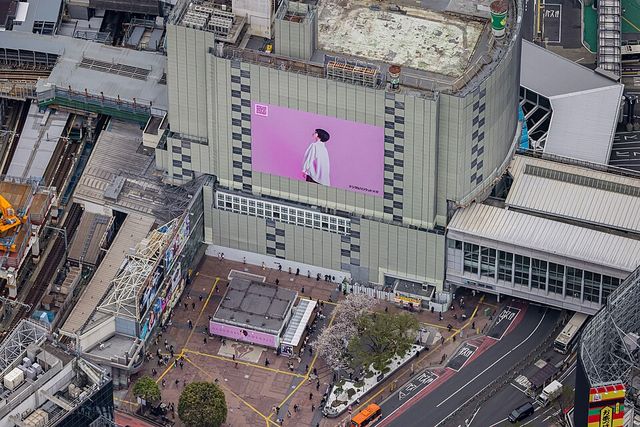
IBA-shibuya-20210325.jpg · Ibamoto · CC BY-SA 4.0
Unmodified image file; scaled to fit the page. Photo remains under its stated license.
- Station
- Shibuya (渋谷)
- Line
- Yamanote Line (山手線)
- Operator
- East Japan Railway Company (東日本旅客鉄道)
- MLIT dataset ID
- 003932 — a dataset identifier, not a passenger signage number
- Dataset reference date
- 2025-12-31
Think in levels as well as exits
JR East publishes a combined first-to-third-floor Shibuya plan. Choose an identifiable gate or exit, then relate it to the place you are visiting. This guide deliberately avoids hard-coding a platform or temporary walkway from memory; the operator map and current signs are the practical references.
Compare journeys from the same endpoint
An editorial comparison with Shinjuku or Ikebukuro should use the same actual destination and start point. The shared Yamanote label makes the records comparable as line features, but it does not establish which complete trip is faster, cheaper or more accessible.
What the preserved record can support
The MLIT snapshot is referenced to 31 December 2025 and identifies a station-line feature operated by JR East. It is useful for geographic reference and matching names. Live operation, fares, platform changes and accessible-route availability are different datasets; the new reading guide does not fill those gaps with assumptions.
Article sources
About this station
Shibuya Station (渋谷駅, Shibuya-eki) is a major railway station in Shibuya, Tokyo, Japan, operated by East Japan Railway Company (JR East), Keio Corporation, Tokyu Corporation, and Tokyo Metro. It serves as a terminal for six railway lines, five of which are operated by Tokyo Metro and Tokyu Corporation. As of 2025, the station is visited by approximately 3 million people per day, making it the second-busiest railway station in the world. The station handles a large population of commuter traffic between the city center and suburbs to the south and west.
JR East
Saikyō Line / Shōnan–Shinjuku Line (Yamanote Freight Line) - also used by Narita Express trains Yamanote Line
Private railways
Keio Inokashira Line - terminus Den-en-toshi Line - through service with Tokyo Metro Hanzomon Line Tōyoko Line - through service with Tokyo Metro Fukutoshin Line
Subways
Ginza Line - terminus Hanzōmon Line - through service with Tokyu Den-en-toshi Line Fukutoshin Line - through service with Tokyu Tōyoko Line Note that while the Tokyo Metro Hanzōmon Line and Fukutoshin Line are directly connected to each other (and passengers can switch from one to another without passing through ticket gates), the Ginza Line station is a standalone terminal. Transfers to the Fukutoshin/Tōyoko Line are given 60 min to do so outside the fare control area, but those needing to transfer to Hanzōmon/Den-en-toshi Line should transfer at the Omotesando station instead.
History
On 1 March 1885, Shibuya Station was opened by the Nippon Railway as a stop on the Shinagawa Line, a predecessor of the present-day Yamanote Line. The station in its first years saw little usage by passengers, with an average of 16 to 17 people per day. The Shinagawa Line itself was initially single-tracked, and the station was serviced by two-car formations making three return trips. Usage increased from 1887, when local residents began to recognize the convenience of rail travel. The Nippon Railway was later nationalized in 1906 under the Railway Nationalization Act. The station was later expanded to accommodate the Tamagawa Line, now a section of the Setagaya Line, in August 1907. The Tokyo Toden extended to the station in August 1911. The station building was rebuilt with a new structure featuring a clock tower.
In 1922, Tamagawa Electric Railway opened the Tenngennji Line which terminates at the station. The station continued to service additional lines, beginning with the Toyoko Line operated by the predecessor of Tokyu Corporation from 1927, and the current Inokashira Line in 1933. The Tokyo Rapid Railway (later the Tokyo Metro Ginza Line) opened and began serving the station in 1938. Developments in the area around Shibuya Station paused during World War II. Following the end of the war, the Den-en-toshi Line (1977), the Hanzōmon Line (1978), and the Fukutoshin Line (2008) began serving the station. Between December 2008 and March 2009, piezoelectric-generating mats were installed at Shibuya Station as a small-scale test. From 22 February 2013, station numbering was introduced on Keio lines, with Shibuya Station denoted "IN01". Station numbering was later introduced to the JR East platforms in 2016 with Shibuya assigned station numbers JS19 for the Shonan-Shinjuku line, JA10 for the Saikyo line, and JY20 for the Yamanote Line. At the same time, JR East assigned three-letter codes to its major transfer stations; Shibuya was assigned the code "SBY".
Redevelopments
In 2013 and 2014, Shibuya station underwent major renovations as part of a long-term site redevelopment plan. Older buildings, such as the former main station building that previously housed the Tokyu department store, were closed and demolished. The Shibuya Hikarie building, also owned by the Tokyu Group, opened in 2012 and contains department stores, restaurants, and offices. JR East rebuilt the station, with reconstruction work beginning in earnest in fiscal year 2015. On 3 January 2020, the Ginza Line platforms were shifted approximately 50 meters (164 ft 1 in) east of the previous location. On 1 June 2020, the Saikyo Line platforms were shifted about 350 meters (1,148 ft 4 in) north of the old platforms, and now sit right next to the Yamanote Line platforms. Major widening work took place on the Yamanote Line inner-loop platform (Platform 2) on 23–24 October 2021. As a result, Yamanote Line service was suspended between Ikebukuro and Osaki. With the opening of the Sotetsu Link Line on 30 November 2019, the Saikyo Line commenced through services onto the Sagami Railway.
On the platform of the Toyoko Line, which was moved to the east side of the station, Tokyu Corporation constructed a 230-meter (754 ft 7 in) high, 47-story commercial building "Shibuya Scramble Square", which became the tallest building in Shibuya upon its opening in November 2019. Other sections of the complex remain under construction and will be completed by 2031. Several commercial buildings connected to the station are scheduled for completion by 2027.
Station layout
The Tokyo Metro Ginza Line, originally built and operated by a Tokyu keiretsu company, uses platforms on the third floor of the station building. The JR lines are on the second floor in a north-south orientation. The Tokyu Toyoko Line originally used parallel platforms on the second floor of the same building, but from 16 March 2013, the Toyoko Line moved underground to provide rail service with the Tokyo Metro Fukutoshin Line. The Tokyo Metro Hanzomon Line and Tokyu Den-en-Toshi Line share platforms underground in another part of the station. The Keio Inokashira Line uses platforms on the second floor of the Shibuya Mark City building to the west of the main station complex. The main JR/Tokyu/Tokyo Metro complex has six exits. The northwest Hachikō Exit (ハチ公口, Hachikō-guchi), named for the nearby statue of the dog Hachikō and located next to Shibuya's famous scramble crossing, is a particularly popular meeting spot. The Tamagawa Exit (玉川口, Tamagawa-guchi) on the west side leads to the Keiō Inokashira Line Shibuya Station platforms. On 17 November 2008 (2008-11-17), a mural by Tarō Okamoto, "The Myth of Tomorrow", depicting a human figure being hit by an atomic bomb, was unveiled in its new permanent location at the station, in the connecting passage to the Keio Inokashira Line entrance.
Platforms
There are two island platforms with a total of four tracks. One of the platforms serves the Yamanote Line and the other serves the Saikyō Line and Shōnan–Shinjuku Line. The station opened in 1885 with one island platform serving what is now the Yamanote Line. To alleviate congestion, a second side platform was opened to the west in July 1940 and the original platform was converted to a side platform. In March 1996, the first Saikyō Line platform was opened. It was located to the south of the Yamanote Line platforms, approximately 350 m (1,148 ft 4 in) away. This platform was relocated to its current location during 30–31 May 2020. The original Yamanote Line platform was then widened during 23–24 October 2021. Further widened during 7–8 January 2023, when the west side platform was removed from service and both directions of the Yamanote Line were recombined into a single island platform.
Platforms
On the third basement (B3F) level, a single underground island platform serves two tracks.
Platforms
Two underground island platforms on the fifth basement (B5F) level serve four tracks. Tokyu has been managing the station since the opening of the Fukutoshin Line in 2008, and the Toyoko Line uses platforms 3 and 4 since the start of through services with the two lines on 16 March 2013.
Platforms
As of January 2020, one island platform serves two tracks. Until December 2019, two side platforms each served one track, with one platform for terminating services and one for services departing towards Asakusa. Due to the distance between the Ginza and Hanzomon Line platforms, transfer information is announced at Omote-sando Station instead.
Platforms
The Keio station consists of two bay platforms serving two tracks. It began operations on 1 August 1933.
Former Toyoko Line station
The former above-ground Tokyu Toyoko Line terminal station platforms were taken out of use after the last train service on 15 March 2013. From the start of the revised timetable on 16 March 2013, Toyoko Line services used the underground platforms 3-4 shared with Tokyo Metro Fukutoshin Line services.
Platforms
The station had four 8-car long bay platforms numbered 1 to 4, serving four tracks.
1953-2000
Source: Tokyo Metropolitan Government
2000-present
In fiscal year 2013, the JR East station was used by 378,539 passengers daily (boarding passengers only), making it the fifth-busiest JR East station. Over the same fiscal year, the Keio station was used by an average of 336,957 passengers daily (exiting and entering passengers), making it the busiest station on the Inokashira Line. In fiscal 2013, the Tokyo Metro Ginza station was used by an average of 212,136 passengers daily and the Tokyo Metro Hanzōmon and Fukutoshin stations were used by an average of 731,184 passengers daily. Note that the latter statistics consider passengers who travel through Shibuya station on a through service as users of the station, even if they did not disembark at the station. In fiscal 2013, the Tokyu Toyoko Line station was used by an average of 441,266 passengers daily and the Den-en-toshi Line station was used by an average of 665,645 passengers daily. The daily passenger figures for each operator in previous years are as shown below.
Note that JR East figures are for boarding passengers only. Note that the Tokyo Metro figures are for the Ginza Line station only. Source: Tokyo Metropolitan Government
Surrounding area
Surrounding the station is the commercial center of Shibuya. The Tokyu Department Store is connected to the east gate of the station and several other department stores are within walking distance.
Shibuya Ward Office NHK Broadcasting Center NHK Hall Shibuya Mark City Shibuya 109 Shibuya Hikarie Yoyogi Park Miyashita Park The Shibuya River flows directly under the station, to the east and parallel to the JR tracks. Unlike most other Japanese department stores, the east block of Tokyu Department Store closed in 2013, and due for demolition as a part of the Shibuya Station redevelopment plan, did not have basement retail space due to the river passing directly underneath. An escalator in the east block of the store was constructed over the river stops a few steps above floor level to make space for machinery underneath without the need for further excavation. Rivers are deemed public space under Japanese law, so building over one is normally illegal. It is not clear why this was allowed when the store buildings were first constructed in 1933.
About text adapted from the Wikipedia article Shibuya Station by its contributors (CC BY-SA 4.0).
Source and licence
出典:国土数値情報(鉄道データ)国土交通省 — このページは「国土数値情報(鉄道データ)N02-2025」を加工して作成した。
Source: National Land Numerical Information (Railway data) N02-2025, Ministry of Land, Infrastructure, Transport and Tourism, Japan; processed and formatted by GIZUMO. Dataset reference date: 2025-12-31. Dataset page: MLIT N02-2025. This archive is a selected sample of station/line features, not live travel information; timetables and current operations are not supplied.