Aikoku Station
Aikoku Station is a former railway station in Obihiro, Hokkaido, Japan. It opened in 1929 and closed in 1987.
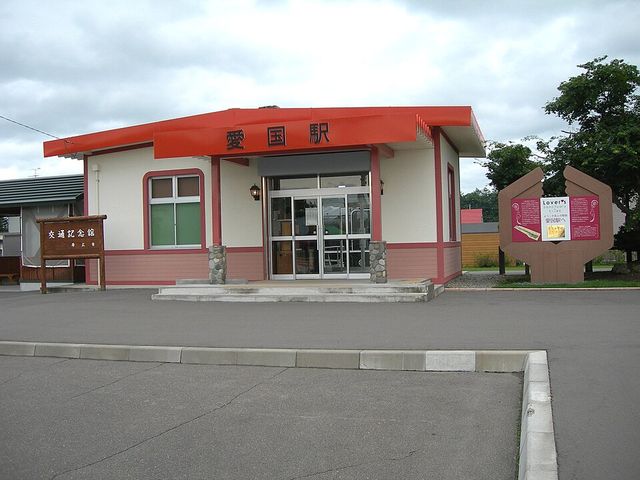
Aikoku Station-20110824.jpg · Rsa · CC BY-SA 3.0
Unmodified image file; scaled to fit the page. Photo remains under its stated license.
- Station
- Aikoku Station
- Opened
- 1929
- Closed
- 1987
- Wikidata item
- Q11073695 — CC0 structured data
At a glance
Aikoku Station is a former railway station in Obihiro, Hokkaido, Japan. It opened in 1929 and closed in 1987.
Lines. Lines recorded for this station: Hiroo Line.
Worth knowing. The station was on the Hiroo Line in Hokkaido. It opened in 1929 and closed in 1987. It became famous through the "From Love Country to Happiness" (Aikoku to Kōfuku) ticket boom.
Reference page built from open data. Not live travel information; timetables, fares and service changes are not supplied here.
About this station
The telegram is Ako. The office management code is 18:111503. With the same station and the catch phrase "From Love Country to Happiness," the boom broke out.
History
General station. (Laughter) December 15th - dismantling cargo and luggage. Dehumanized. August 1 - construction of the train station. I'm selling 45,000 tickets.
From Station Name
It's from your location. It's based on the patriotic Youth organization that opened up the area.
Station structure
At the time of the end of the war, it was a single home-lined ground station. The home existed on the right side of the track towards the west end of the road. It was once a train exchange station with two-sided relative homes. The abandoned station and the other side of the line remained on the sidelines after the end of the exchange facilities, and by the time of 1983 the platform had been removed.) In addition, the main line branched off to the side of the station, and the cargo line to the home on the north side of the station was one line, and the end line of a two-way street that was branched from the upper side of the back line. It's essentially a dead-off train station, but the assistant at Otaka Station serves as a helper for this station, and it was essentially a manned station. The station was located in the south west corner of the building and bordered the center of the home. The home was built with station names and gardens that followed the ticket from "Hawamoto from the country." There was a "My Travel stamp" set up. Also, since the sale of ticket tickets to the station's pre-tax store was going on separately, the tickets from the "Famiji" ticket from the country were either from the private station, from which the steel was directly sold during the time of the tourist season, or from what was used mainly by the adults and children who were sold in the store for the year and year-olds. And for the former, there was a difference between the regular printing of the printed page and the printout of an external order at the time of the boom. There was also a shop next to the station that used the body of the Yo3500 car.
Use Status
The number of passengers on the first day of 1981 is 742.
Near the station
The National Post Office of the Republic of China.
The train tracks
It's organized by Obihiro as the "Sacred Traffic Memorial." The old station has a storage display of block blockage, signal, equipment, ticket, station stamp and photo panels that were used at the time. The station's area is also kept as it was then open, and the 9600 - type steam locomotive is still on display on the tracks. It was the same at the beginning. There's also a stela with a VCR ticket on it, and a stela that commemorates the sale of 10 million tickets. However, the shop that re-used the Jo500 car beside the station has been abandoned at the time of 2011. Also, the surrounding area, including the Memorial, is equipped as a park with heart-shaped fountains, toys, and barbecue cabins.
"From Love Country to Happiness" Boom
In March of 1973, the NHK's feature show was taken along with Happy Station as a happy name, making it popular nationally. In July of 1978, the number of tickets for the "Brazil happy" ticket broke through 10 million tickets. In the end, 12 million yen and the total sales total amounted to 940 million yen. A monument will be erected in front of the station by the Tohoku Railroad Administration. In addition to being currently sold in a store in front of the station with a ticket receipt with a specific case holder, even a ten-winning bus will sell a bus ticket from the country.
About text translated and adapted from the Japanese Wikipedia article 愛国駅 by its contributors (CC BY-SA 4.0).
Sources & records
Original English guide generated from Wikidata and Wikimedia Commons records · sources checked 2026-11-01. This is a source-check date, not a new publication or live availability claim.
- Wikidata: Aikoku Station (Q11073695) · checked 2026-11-01
- Wikimedia Commons: Aikoku Station-20110824.jpg · checked 2026-11-01
